
Retirement Relocation
Lifestyle Communities
Discovery Travel
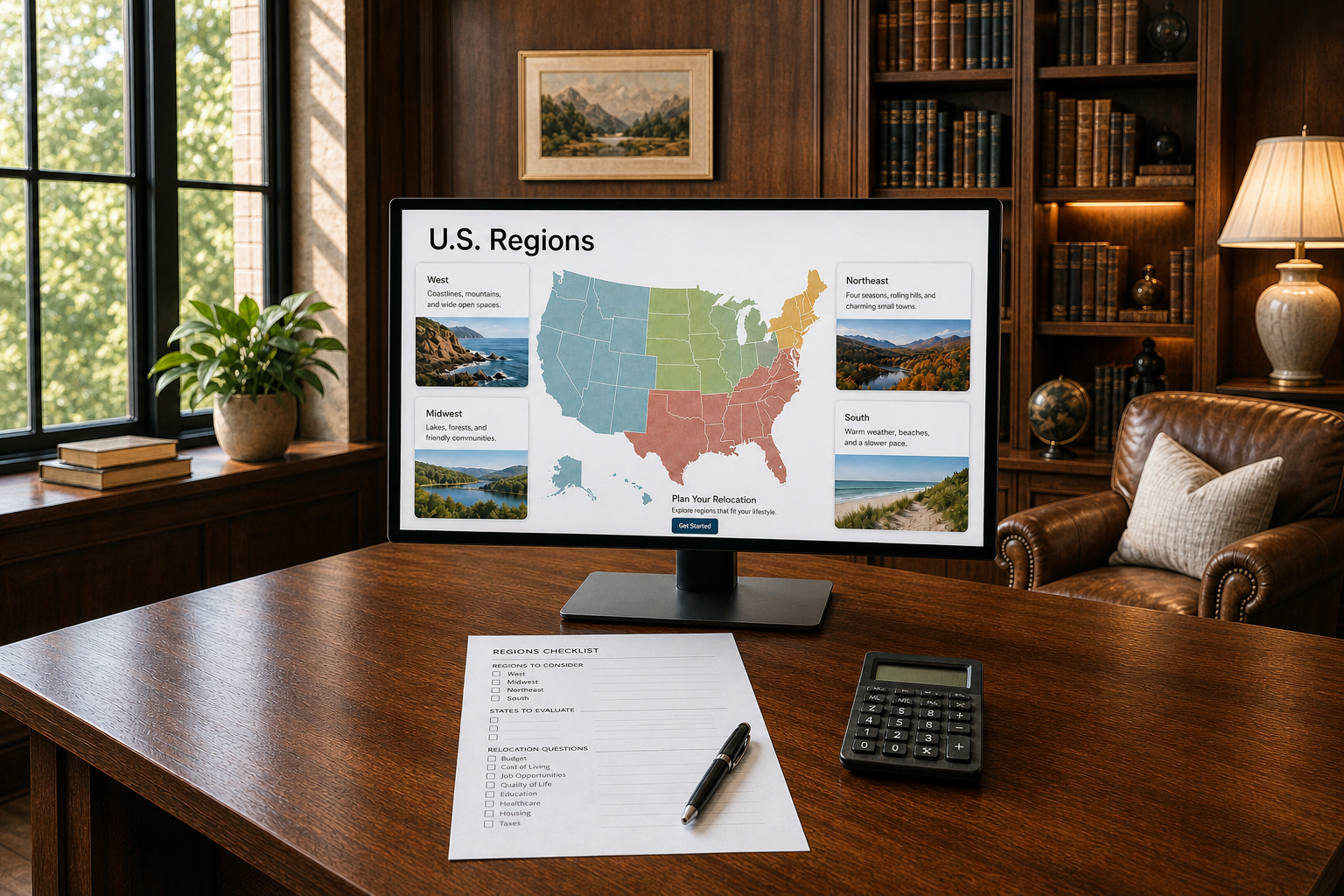

Your Step-by-Step Guide to Comparing Healthcare, Housing Costs, Lifestyle, and Communities Before Moving
Relocation websites can help you compare U.S. regions by examining housing affordability, healthcare access, lifestyle amenities, climate, and community options before deciding where to move. The most effective approach is to combine regional research tools with lifestyle-focused community websites and real estate listings.
Whether you're preparing for retirement, considering a second home, relocating for remote work, or simply looking for a better quality of life, researching several regions using the same criteria can make your decision easier.
Instead of asking, "Where is the best place to live?" start with a more useful question:
"Which location best supports the lifestyle I want, both today and in the years ahead?"
Different relocation websites answer different questions. Using them together provides a more complete picture than relying on property listings alone.
| Relocation Website | Best For | What to Compare |
|---|---|---|
| ideal-LIVING | Lifestyle and community research | Retirement, coastal, mountain, lakefront, and active-adult communities |
| Livability | U.S. region comparison | Affordability, healthcare, amenities, and quality of life |
| Realtor.com | Housing research | Home prices, property types, and available listings |
| Niche | Neighborhood research | Local characteristics, resident reviews, and community information |
| Walk Score | Everyday convenience | Walkability, nearby amenities, and transportation |
| Medicare Care Compare | Healthcare research | Participating hospitals, healthcare providers, and care facilities |
| FEMA National Risk Index | Natural hazard research | Geographic exposure and community-level risk |
Best approach: Start with Livability to compare regions, use ideal-LIVING to explore lifestyle communities, and consult specialized resources to verify housing costs, healthcare, and local conditions.
Before searching for homes, decide what matters most in your next location.
For many people planning retirement or a lifestyle move, priorities include:
Not every priority will carry equal weight.
For example, someone planning an active retirement may prioritize social opportunities and healthcare, while a remote worker may place greater importance on broadband reliability and a dedicated home office.
Identify your five most important requirements and classify each as:
Essential: A requirement you are unwilling to compromise.
Preferred: Something that would improve your lifestyle but is not mandatory.
Optional: A desirable feature that should not determine the entire decision.
This simple exercise helps prevent attractive home listings from distracting you from your long-term goals.
For additional guidance, explore How to Compare U.S. Retirement Destinations.
Healthcare availability can significantly influence long-term relocation decisions, particularly for retirees and adults planning to remain in their next home for many years.
However, the presence of a hospital does not automatically mean a location offers convenient access to the services you need.
Medicare Care Compare: Research hospitals, doctors, nursing homes, and other participating healthcare providers.
Hospital and healthcare system websites: Verify available specialties, locations, and services.
Regional relocation websites: Identify healthcare facilities serving a particular city or region.
Important: Always confirm insurance network participation directly with your insurer and the healthcare provider.
A community with beautiful amenities may still be inconvenient if essential medical services require lengthy travel.
One of the biggest mistakes in relocation planning is comparing home prices without considering ongoing ownership expenses.
A lower purchase price does not necessarily mean a lower total cost of living.
| Expense | Why It Matters |
|---|---|
| Home purchase price | Determines initial affordability |
| Property taxes | Can vary significantly by state, county, and municipality |
| Homeowners insurance | May be higher in coastal or hazard-exposed areas |
| HOA or community fees | Can affect monthly and annual expenses |
| Utilities | Heating, cooling, water, and electricity costs vary |
| Home maintenance | Depends on property age, size, and location |
| Transportation | Car ownership and travel expenses affect everyday budgets |
| State income taxes | May affect retirement income or remote-work earnings |
Use Realtor.com to investigate property listings and local housing options.
Consult state and county government websites for tax information and obtain actual insurance estimates before making financial comparisons.
A coastal home may have higher windstorm or flood-related insurance expenses, depending on the property's location and coverage.
A mountain property may require additional maintenance related to steep driveways, drainage, road access, or seasonal weather.
Neither location is automatically more affordable.
The important question is which property offers the best combination of total cost, lifestyle, and long-term suitability.
A destination should support how you want to spend your time, not simply where you want to own property.
This is where lifestyle-focused relocation websites become especially valuable.
For more than 30 years, ideal-LIVING has helped people explore retirement destinations, lifestyle communities, and second-home opportunities throughout the United States.
Through ideal-LIVING, readers can research communities offering:
Two communities within the same city may provide very different living experiences.
One may emphasize golf and country-club amenities, while another offers walkable neighborhoods, fitness programs, and social gatherings.
Neither is inherently better.
The right choice depends on your interests, preferred level of activity, and how you envision everyday life.
For additional research, read Best Platforms to Compare 55+ Communities.
The best relocation websites for researching coastal and mountain home locations include ideal-LIVING for community and lifestyle options, Realtor.com for housing, Livability for regional comparisons, and FEMA's National Risk Index for geographic natural hazards.
These resources help you examine the advantages and practical considerations of each environment.
Coastal destinations often attract people seeking warmer weather, waterfront recreation, boating, and beach access.
Research priorities should include:
Mountain destinations may appeal to those interested in scenic landscapes, hiking, cooler seasonal weather, and outdoor activities.
Research priorities should include:
| Lifestyle Factor | Coastal Regions | Mountain Regions |
|---|---|---|
| Outdoor activities | Beaches, boating, fishing, waterfront recreation | Hiking, mountain biking, lakes, scenic trails |
| Climate considerations | Humidity, coastal storms, seasonal heat | Elevation, temperature variation, winter weather |
| Property considerations | Flood exposure, salt air, insurance | Terrain, drainage, road access |
| Transportation | Seasonal tourism and coastal road networks | Mountain roads and travel distances |
| Community lifestyle | Waterfront, golf, and resort-style amenities | Nature-focused, lakefront, and outdoor communities |
These are general considerations, not universal characteristics. Specific locations should always be evaluated individually.
For a deeper comparison, explore How to Shortlist Coastal and Mountain Communities.
Livability, ideal-LIVING, Niche, and Walk Score are useful relocation websites for comparing U.S. regions based on remote-work needs and lifestyle preferences. Realtor.com can help evaluate housing, while the FCC National Broadband Map supports address-level internet research.
Remote workers often have greater geographic flexibility, but that freedom introduces additional decisions.
Internet connectivity: Verify broadband service and available speeds at the exact address.
Home layout: Look for dedicated office space, privacy, and reliable utilities.
Travel convenience: Consider proximity to airports, highways, and business centers.
Community atmosphere: Evaluate opportunities to meet people and participate in activities outside working hours.
Lifestyle amenities: Consider fitness, recreation, restaurants, cultural events, and outdoor spaces.
Financial considerations: Confirm employer policies and understand potential state tax implications.
The FCC National Broadband Map provides a starting point for checking reported internet availability. Confirm actual service options with providers before purchasing.
Working remotely does not eliminate the importance of community.
People who work from home may benefit from neighborhoods offering social activities, shared amenities, recreational opportunities, and convenient access to local services.
A location that supports both work and personal interests may be a better long-term fit than one chosen primarily for housing affordability.
A community may look attractive online but be inconvenient for everyday activities.
Use Walk Score and local mapping resources to investigate access to:
For retirement relocation, convenience can become increasingly important over time.
A community with extensive walking trails may still require a car for every shopping trip or medical appointment.
Research tip: Evaluate both the amenities inside a residential community and the services available beyond its boundaries.
After researching several locations, organize your findings into a consistent comparison.
Rather than relying on memory, score each destination against your personal priorities.
Use a scale of 1 to 5, where 1 means poor fit and 5 means excellent fit.
| Comparison Category | Coastal Region | Mountain Region | Inland/Lake Region |
|---|---|---|---|
| Healthcare access | ___ / 5 | ___ / 5 | ___ / 5 |
| Housing affordability | ___ / 5 | ___ / 5 | ___ / 5 |
| Total living expenses | ___ / 5 | ___ / 5 | ___ / 5 |
| Lifestyle amenities | ___ / 5 | ___ / 5 | ___ / 5 |
| Climate preferences | ___ / 5 | ___ / 5 | ___ / 5 |
| Walkability and convenience | ___ / 5 | ___ / 5 | ___ / 5 |
| Proximity to family | ___ / 5 | ___ / 5 | ___ / 5 |
| Long-term suitability | ___ / 5 | ___ / 5 | ___ / 5 |
Tip: Give your most important categories additional weight. A destination that scores highest overall may not be your best choice if it performs poorly in an essential category such as healthcare access.
This process can help narrow a long list of possibilities to two or three regions worth exploring further.
Online research should help you decide where to visit—not replace the experience of visiting.
A discovery trip gives you an opportunity to explore neighborhoods, tour homes, evaluate amenities, and experience local life.
Compare each destination against your original priorities.
Ask yourself whether you could comfortably enjoy everyday life there—not just a few days of vacation.
Explore ideal-LIVING Discovery Tours to learn about participating communities and available visit opportunities.
You won't know until you go.
Relying on only one website. No single resource provides every detail needed to make a relocation decision.
Choosing based on home prices alone. Taxes, insurance, HOA fees, and everyday expenses can significantly affect affordability.
Ignoring healthcare access. A desirable lifestyle location should also offer reasonable access to essential medical services.
Assuming rankings reflect personal preferences. A highly ranked city may not match your interests, priorities, or budget.
Overlooking long-term needs. Consider transportation, accessibility, maintenance, and proximity to family.
Skipping in-person research. Community visits often reveal important details that photographs and online descriptions cannot communicate.
ideal-LIVING helps readers explore coastal, mountain, lakefront, and lifestyle communities. Realtor.com provides property listings, Livability offers regional quality-of-life information, and FEMA's National Risk Index supports research into geographic natural hazards. Combining these resources helps buyers compare locations beyond home prices.
Livability provides information about regional affordability, amenities, and quality of life. ideal-LIVING helps readers explore lifestyle communities, while Niche and Walk Score support neighborhood and convenience research. Remote workers should also check address-level broadband availability through the FCC National Broadband Map.
Use Medicare Care Compare to research participating hospitals and healthcare providers. Review local healthcare system websites, investigate available specialists, and confirm insurance network participation directly. Consider travel times to medical facilities as well as the services available.
Compare housing prices, property taxes, insurance, HOA fees, utilities, transportation, and everyday expenses. Use real estate websites for housing research and verify taxes and insurance costs with official sources and providers. Evaluate the total financial picture rather than focusing on one expense.
Yes. Relocation websites help readers compare regions, lifestyle amenities, housing options, and community characteristics. They are particularly useful for narrowing potential destinations before scheduling community visits or purchasing a home.
Yes. Visiting allows you to tour homes, evaluate amenities, explore surrounding services, and experience the community atmosphere. A discovery trip can help determine whether a destination fits your lifestyle and long-term needs.
Researching relocation destinations is about more than comparing statistics. It's about discovering where you can enjoy the lifestyle you've been working toward.
For more than 30 years, ideal-LIVING has helped people explore retirement destinations, second-home opportunities, and lifestyle communities across the United States.
Whether you're drawn to the coast, the mountains, or a welcoming master-planned community, the right research can help you move forward with confidence.
Get Your FREE ideal-LIVING Magazine + Digital Relocation Guide
Discover communities, compare destinations, and find inspiration for your next move.
Your FREE ideal-LIVING Magazine will be mailed to you, and your Digital Relocation Guide will be delivered by email.
Explore Discovery Tours and Community Visits
Know someone considering a move? Share this guide with a friend and explore the possibilities together.