Best Places to Live
Retirement Relocation
Second Homes


The right second-home destination is not the one that tops a national ranking. It is the one that supports the life you want to live when you are away from your primary residence.
For people exploring a second-home destination, the decision involves far more than home prices and proximity to an airport. Climate, tax structure, seasonal access, community amenities, healthcare, and everyday lifestyle all shape whether a location will feel like an extension of your life or a burden you visit out of obligation. This guide walks through each of those factors and offers a regional framework you can apply to your own priorities.
ideal-LIVING helps prospective movers compare U.S. destinations by lifestyle fit, cost of living, and community type. The sections below cover everything from defining your lifestyle goals to evaluating specific regions, understanding tax and travel logistics, and building a structured decision-making process.
A second home is a property you own in addition to the residence where you spend the majority of the year. Lenders and the IRS generally classify a second home as a dwelling used personally for at least 14 days per year (or 10 percent of the days it is rented, whichever is greater).
That classification separates second homes from investment properties, which carry different mortgage rates, tax rules, and insurance requirements. If you plan to rent your second home for part of the year, the distinction affects your deductions and reporting obligations.
Understanding the category your property falls into shapes financing, insurance costs, and long-term tax planning. A qualified tax professional should be consulted before making decisions based on an individual tax situation.
Start with lifestyle before looking at houses. Too many prospective movers focus on home prices and skip the question that matters most: What do you want an ordinary week at your second home to look like?
Think about whether you picture yourself walking to a waterfront, playing golf three mornings a week, hosting family for long weekends, or spending quiet afternoons in a mountain setting. Those answers narrow the geography far more effectively than browsing listings by price range.
Create three categories to organize your priorities: Must Have, Would Like, and Don't Want. A Must Have might be year-round warm weather. A Would Like could be a golf community. A Don't Want might be heavy tourist traffic during peak months. Once those priorities are clear, comparing destinations becomes much easier.
Seasonality determines when your second home is usable, how rental demand fluctuates, and what maintenance costs look like during off-peak months. A coastal South Carolina property may offer ten months of comfortable weather, while a mountain home in Colorado could require winterization and limited access during heavy snow.
For part-time residents who plan to visit during specific seasons, matching your intended use pattern to the destination's climate calendar is essential. NOAA's official U.S. Climate Normals offer long-term temperature, precipitation, and weather data for thousands of U.S. locations, making it possible to compare seasonal conditions at a granular level.
If you expect to use the property year-round, prioritize destinations with moderate climates and infrastructure designed for full-time occupancy. Coastal areas of North Carolina, parts of Georgia, and portions of the Gulf Coast tend to support year-round access without extreme seasonal disruption.
How easily you can reach your second home affects how often you will use it. A property that requires two connecting flights and a 90-minute drive from the airport may sound appealing during a vacation search, but the travel burden reduces actual visit frequency.
Consider properties that sit two to four hours by car from your primary residence or offer nonstop flights from your home airport. Direct-flight access makes weekend use realistic, and shorter travel time lowers the threshold for impromptu visits.
Regional airports near popular second-home markets have expanded service in recent years. Destinations such as the Hilton Head Island area, Asheville, and Myrtle Beach in the Carolinas benefit from improved air connectivity that supports both planned trips and spontaneous getaways.
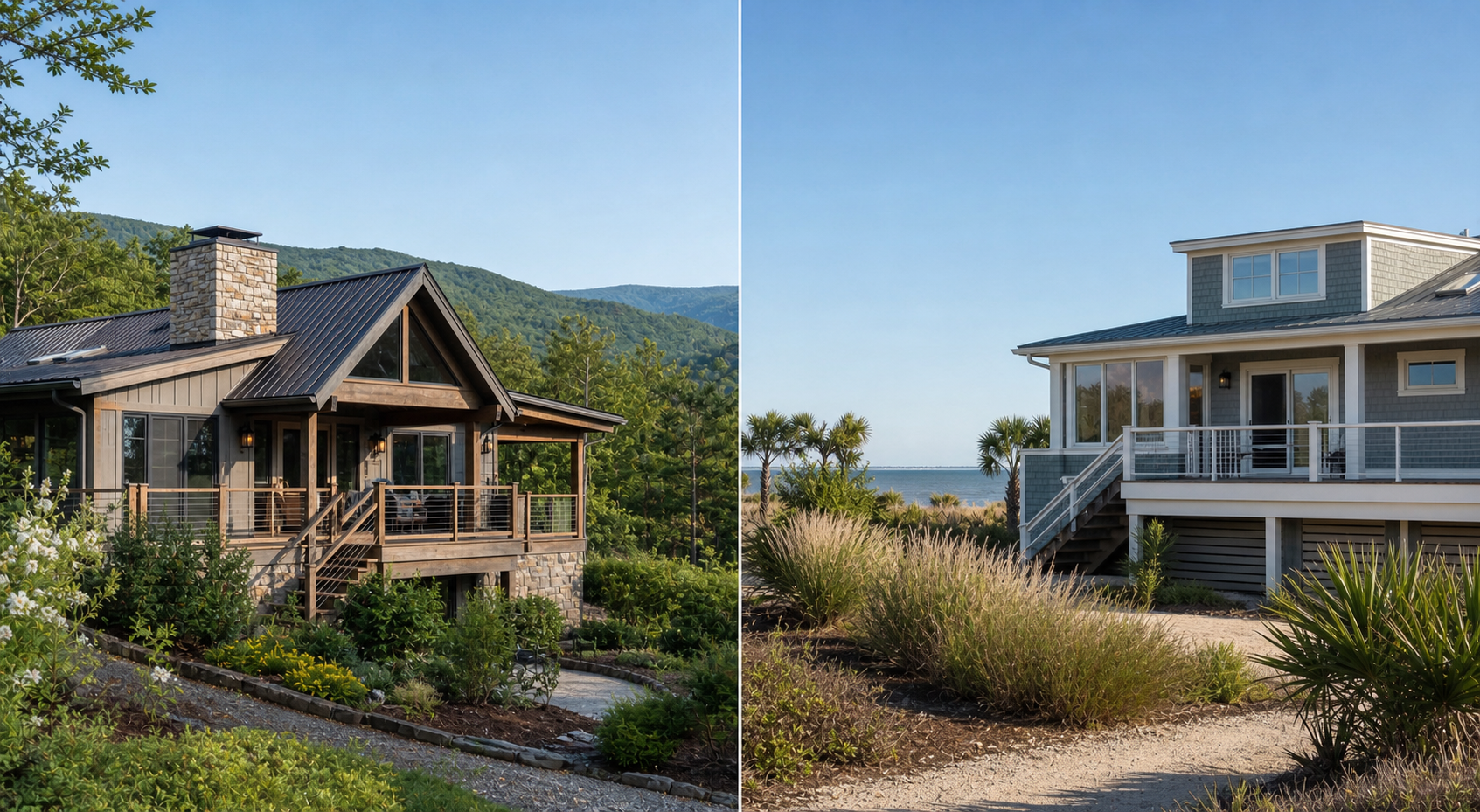
Each U.S. region offers a distinct combination of climate, cost, and lifestyle for second-home buyers. The sections below break down four broad categories: coastal Southeast, mountain destinations, Gulf Coast and Florida, and the Southwest. That said, no region should be treated as a single lifestyle. Variation can be dramatic even across communities located in the same state.
The coastal Southeast continues to stand out for people considering a second home. Recent U.S. Census population estimates reinforce strong migration to both Carolinas. South Carolina was the fastest-growing state by percentage between July 2024 and July 2025, growing approximately 1.5 percent. North Carolina ranked third at approximately 1.3 percent.
Destinations along the South Carolina coast, from the Lowcountry to the Grand Strand, offer golf communities, waterfront living, and mild winters. North Carolina ranges from Outer Banks beach towns to the Wilmington area, each supporting a different pace of life. Coastal Georgia, including communities near St. Simons Island and the Golden Isles, combines mild year-round weather with smaller-town character.
Living near the coast doesn't require living directly on the beach. For many prospective residents, a community 15 to 45 minutes inland can sometimes offer more housing choices, larger homesites, and easier access to shopping and healthcare.
Mountain communities appeal to people who want four-season living, outdoor recreation, and cooler summer temperatures. The Blue Ridge region of western North Carolina, including areas near Asheville and Lake Lure, draws second-home buyers who value hiking, waterfalls, and a growing arts and food culture.
Tennessee's Smoky Mountain foothills and communities along Tellico Lake offer a similar combination of natural beauty and lower cost of living. Tennessee does not impose a state individual income tax on wages, which can factor into long-term financial planning for part-time residents.
When evaluating mountain locations, consider road accessibility during winter, healthcare proximity, and the distance to a regional airport. A mountain retreat with limited winter road access may work for summer-only use but less so for year-round visits.
Florida should not be treated as a single lifestyle. The state's panhandle offers white-sand beaches and a pace that differs significantly from the Gold Coast or the Gulf barrier islands further south. Parts of Florida's west coast, including areas near Sarasota and Naples, attract second-home buyers drawn to waterfront dining, cultural events, and golf community options.
Alabama's Gulf Coast, including Dauphin Island and the Orange Beach corridor, represents a lower-cost entry point for prospective movers who want Gulf access without Florida-level home prices. Mississippi's Gulf region has also attracted renewed interest for similar reasons.
Prospective residents should evaluate hurricane risk, flood insurance costs, and homeowners association structures before committing. Insurance premiums along the Gulf can vary considerably between barrier islands and mainland communities.
The Southwest appeals to people who prefer dry heat, desert landscapes, and lower humidity. Arizona continues to attract second-home buyers to areas near Scottsdale, Sedona, and Tucson, where golf, hiking, and outdoor dining are year-round activities.
New Mexico offers a distinct cultural identity, particularly around Santa Fe and Taos, where art galleries, historic architecture, and high-desert scenery create a setting unlike any other U.S. destination.
Total cost of living in the Southwest can be lower than in coastal markets, though property taxes, water costs, and HOA structures vary by community. As with any destination, costs can vary considerably between resort-style developments and smaller rural towns.
Low state taxes do not automatically mean a lower total cost of living. Prospective movers should consider the complete tax picture, including:
States such as Florida, Tennessee, and Texas do not impose a state income tax on wages, which can be advantageous for second-home buyers earning income. South Carolina and North Carolina have moderate income tax structures but may offset that with lower property tax rates in certain counties.
Beyond taxes, evaluate insurance premiums, HOA fees, utility costs, and maintenance expenses. A qualified tax professional should be consulted before making decisions based on an individual tax situation.
The community you choose shapes your daily experience as much as the destination itself. Master-planned communities often include pools, fitness centers, walking trails, clubhouses, and organized social events. For second-home buyers who spend weeks or months at a time in one location, these amenities reduce isolation and build a sense of belonging.
Golf communities, waterfront communities, and active-adult communities each serve different lifestyle preferences. The more important question is whether the community supports the way you actually want to spend your time.
ideal-LIVING's community search tool lets you filter destinations by amenities, location, and lifestyle type, which helps narrow options before scheduling discovery visits. Spending time in a community before purchasing, rather than relying solely on brochures and virtual tours, can reveal whether the day-to-day atmosphere matches your expectations.
Yes. Visiting a destination before purchasing a home is one of the most valuable steps in the relocation process. Online research can help narrow your choices, but it cannot completely answer questions about traffic patterns, noise levels, the feel of a neighborhood, or how actively residents use the amenities.
When visiting, spend time in the community during both weekdays and weekends. Ask yourself:
Visit your top destinations more than once and, when possible, during different seasons. A community that feels vibrant in March may be significantly quieter in August, or the reverse.
Step 1: Clarify your lifestyle priorities. Write down how you want to spend a typical day at your second home. Focus on activities, not property features. Do you want mornings near the water, afternoons on the golf course, evenings at restaurants? Or do you prefer quiet trails, reading on a screened porch, and small-town Saturday markets?
Step 2: Organize your priorities into Must Have, Would Like, and Don't Want categories. Be honest about trade-offs. You may want beachfront and low property taxes, but those two factors rarely overlap.
Step 3: Research regions, not just cities. Use the regional breakdowns in this guide to identify two or three areas that align with your priorities. ideal-LIVING's destination comparison tools help you evaluate communities by lifestyle fit, amenities, and location.
Step 4: Evaluate financial factors for each destination. Calculate total cost of ownership, including mortgage, taxes, insurance, HOA fees, travel costs, and maintenance. Compare these figures across your shortlisted regions.
Step 5: Visit your top two or three choices. Schedule discovery visits or stay-and-play opportunities that let you experience a community's daily rhythm. Talk to current residents and ask about both the advantages and the trade-offs they have encountered.
Step 6: Revisit in a different season before committing. A second visit during the off-peak season reveals the community's year-round character and helps you avoid surprises after closing.
Buying based on a single vacation experience is one of the most common missteps. A week-long stay during peak season shows the destination at its most polished, not necessarily at its most representative.
Underestimating ongoing costs is another frequent issue. Homeowners insurance, flood coverage, and HOA fees can add thousands of dollars to annual expenses that were not part of the initial budget.
Skipping the lifestyle-first approach and focusing only on home prices leads to purchases that look good on paper but don't match day-to-day preferences. A beautiful house cannot compensate for choosing the wrong location or lifestyle.
ideal-LIVING connects prospective movers with curated community listings, editorial content in the magazine, and live events where you can meet community representatives in person. The platform's search tools let you filter by location, community type, and lifestyle amenities.
For prospective buyers who want face-to-face conversations with community experts, the Best Places to Live Expo brings multiple destinations together in a single weekend. These events offer a concentrated way to compare options and gather information without scheduling individual visits to each community.
ideal-LIVING's approach focuses on matching you with a destination and community that fits your priorities, rather than ranking places by a single metric.
The best second-home destination is not the one at the top of a national ranking. It is the place that supports the life you want to live when you step away from your primary residence.
A coastal community in the Carolinas may appeal to someone who wants year-round mild weather and waterfront recreation. A mountain retreat in Tennessee or western North Carolina may be better for someone who values four-season living and lower cost of living. A Southwest desert property could be the right fit for a buyer drawn to dry heat, outdoor dining, and cultural richness. Someone else may reach a completely different conclusion based on entirely different priorities.
Research several destinations. Compare the total cost of living. Explore different types of communities. Visit the places that interest you.
Can you picture the life you want to live there? If the answer is yes, you've found a destination worth pursuing.
Define the lifestyle you want before evaluating locations. Write down how you picture spending an ordinary week at your second home, then sort those priorities into Must Have, Would Like, and Don't Want categories.
ideal-LIVING's community search helps you match lifestyle preferences to specific destinations and communities across the U.S.
Second homes may carry higher mortgage rates and different deduction rules than your primary residence. Some states offer favorable tax treatment for property owners, while others impose additional taxes on non-primary residences.
A qualified tax professional should be consulted before making decisions based on your individual situation.
Visit at least twice, ideally during different seasons. A peak-season trip shows the destination at its busiest, while an off-season visit reveals year-round character.
ideal-LIVING offers discovery visits and stay-and-play experiences that let you spend extended time in a community before making a commitment.
No. ideal-LIVING features master-planned communities, waterfront communities, golf communities, and resort-style communities for buyers of all ages. The platform covers both age-restricted and mixed-age options.
The coastal Southeast (the Carolinas, Georgia, Florida) continues to attract strong interest. Mountain regions in North Carolina and Tennessee, the Gulf Coast, and the Southwest (Arizona, New Mexico) are also popular among second-home buyers.
ideal-LIVING's regional guides break down what each area offers by lifestyle, climate, and cost of living to help you compare destinations.