
Best Places to Live
Retirement Relocation
Second Home Living
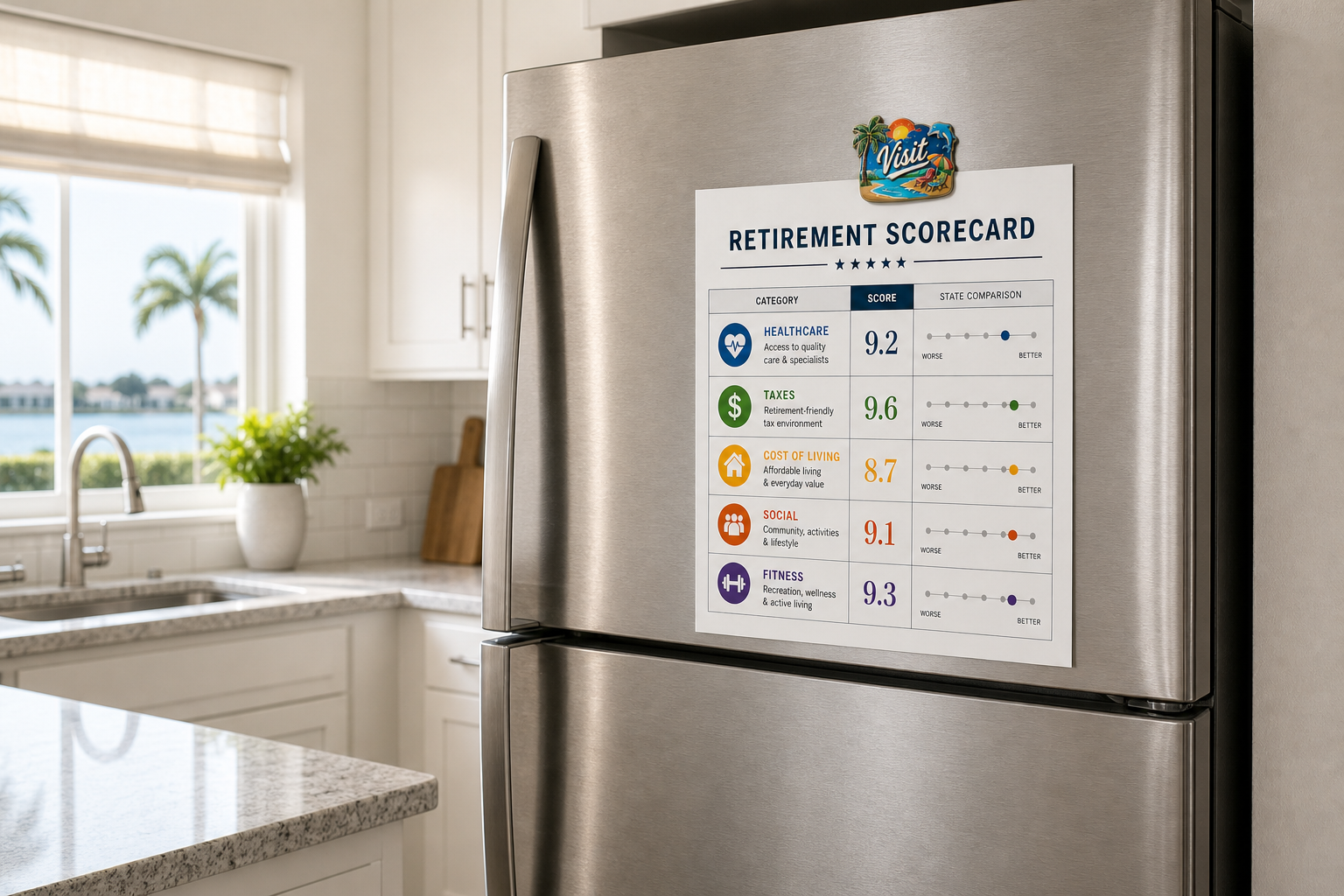

Choosing where to retire is one of the most important lifestyle decisions you'll make. Whether you're drawn to the Carolinas, Florida, Tennessee, Georgia, Virginia, or another destination, the right location should offer more than attractive homes and pleasant weather.
Healthcare access, taxes, housing costs, community services, and everyday lifestyle all influence how comfortable and fulfilling your retirement years can be.
Retirement relocation guides can help organize these considerations, but comparing several destinations becomes much easier when you use a consistent evaluation system.
This 2026 retirement relocation guide includes a practical scorecard to help you compare U.S. retirement communities, evaluate retirement-friendly states, and narrow your options before scheduling discovery visits.
Several resources provide useful information for researching retirement destinations in the United States.
The most effective approach combines relocation guides, independent government data, financial research, and community-specific information.
| Resource | What it helps you compare | Best use |
|---|---|---|
| ideal-LIVING | Retirement destinations, lifestyle communities, amenities, and relocation considerations | Discovering communities and organizing lifestyle priorities |
| Livability | Cities, towns, amenities, and quality-of-life factors | Comparing regional lifestyles and local services |
| 55places | 55+ communities, home options, and community amenities | Researching active adult neighborhoods |
| Kiplinger | Retirement finances, taxes, and financial planning | Evaluating financial implications of relocation |
| Tax Foundation | State and local tax policies | Researching differences in tax structures |
| Medicare Care Compare | Participating healthcare providers and facilities | Researching healthcare options |
| U.S. Census Bureau | Population, demographics, and community characteristics | Understanding regional trends and population patterns |
The key takeaway: No single publication or website can fully evaluate every aspect of retirement relocation. Use a lifestyle-focused guide such as ideal-LIVING alongside independent financial, healthcare, and local government resources.
Without a structured comparison, it's easy to become distracted by attractive homes, beautiful scenery, or a favorable state tax ranking.
A retirement relocation scorecard helps you:
The goal isn't to identify one universally perfect retirement destination. It's to identify the places that best fit your individual circumstances.
Taxes are an important consideration when relocating, but the absence of a state income tax doesn't automatically mean a destination will have the lowest overall cost of living.
A complete tax comparison should examine several categories.
| Tax consideration | What to research | Why it matters |
|---|---|---|
| State income tax | Treatment of retirement income and other earnings | May affect annual retirement income |
| Social Security taxation | Whether the state taxes Social Security benefits | Can influence after-tax income |
| Pension and retirement account income | State rules for pensions, IRAs, and retirement distributions | Treatment varies by state and income source |
| Property taxes | Local rates, assessed values, and exemptions | Directly affects housing expenses |
| Sales taxes | State and local rates | Influences everyday spending |
| Estate and inheritance taxes | Applicable state rules | May affect estate planning |
The following states are commonly researched by people considering retirement relocation.
| State | Tax consideration | Lifestyle consideration |
|---|---|---|
| North Carolina | Compare state income tax, property taxes, and retirement income treatment | Coastal towns, mountain communities, and planned neighborhoods |
| South Carolina | Review retirement income deductions and property tax provisions | Coastal communities, golf, and active adult lifestyles |
| Florida | No individual state income tax | Beaches, warm weather, and numerous lifestyle communities |
| Georgia | Review applicable retirement income exclusions and local taxes | Coastal destinations, lakes, and mountain regions |
| Tennessee | No broad individual income tax on wages or retirement income | Mountain living, lakes, and lower-density communities |
| Virginia | Review retirement income treatment and local property taxes | Historic towns, coastal areas, and mountain destinations |
Important: Tax laws, exemptions, and eligibility requirements can change. Confirm current rules with state revenue departments and a qualified tax professional before making a financial decision.
For more information, read our guide to tax-friendly retirement states for 55+ living.
Healthcare access deserves careful consideration, even if you're currently healthy and active.
A destination may offer attractive housing and recreational amenities but have limited access to specialists or major medical facilities.
| Healthcare factor | Questions to ask |
|---|---|
| Hospitals | How far is the nearest hospital? What services does it offer? |
| Primary care | Are local physicians accepting new patients? |
| Specialists | Are relevant specialists available nearby? |
| Emergency care | What emergency services and response options serve the area? |
| Medicare access | Do local providers accept your coverage? |
| Pharmacies | Are pharmacies conveniently located? |
| Rehabilitation services | Are physical therapy and rehabilitation facilities available? |
| Long-term care | What assisted living, memory care, or continuing care options exist nearby? |
| Transportation | Are there practical options for reaching medical appointments? |
Start with Medicare Care Compare to research participating facilities and providers.
You should also contact local hospitals, physician practices, and insurance providers directly to confirm current services, network participation, and appointment availability.
Retirement planning tip: Evaluate healthcare access based on both your current needs and the services you may want available in the future.
For additional guidance, explore our healthcare and services guide for retirement moves.
A retirement-friendly community should support everyday living, not just recreation.
When researching potential destinations, evaluate the availability of:
A location that feels convenient during a weekend visit may be less practical for year-round living.
Consider how often you'll need to drive, whether services are accessible during different seasons, and how easily you can maintain an active social life.
For retirees seeking greater convenience, walkable neighborhoods and communities with nearby services may deserve additional consideration.
Choosing the right state is only the beginning.
Two retirement communities in the same region can offer very different lifestyles.
When comparing U.S. retirement communities, research the amenities and services that matter most to you.
| Community feature | What to verify |
|---|---|
| Walking trails and sidewalks | Connectivity, accessibility, and maintenance |
| Fitness and wellness facilities | Equipment, classes, operating hours, and fees |
| Swimming pools | Indoor or outdoor access and seasonal availability |
| Social clubs | Variety of activities and resident participation |
| Golf and recreation | Membership requirements and additional costs |
| Community events | Frequency, variety, and opportunities to meet neighbors |
| Home maintenance | HOA responsibilities and homeowner obligations |
| Security features | Access arrangements and available services |
| Guest accommodations | Visitor policies and guest access to amenities |
Age-restricted communities can appeal to buyers seeking an active adult lifestyle with amenities and neighbors in a similar stage of life.
However, some retirees prefer multigenerational master-planned communities or traditional neighborhoods.
The best choice depends on your social preferences, family circumstances, housing needs, and desired lifestyle.
A lower home price doesn't necessarily mean a lower overall cost of living.
Compare the full cost of purchasing and maintaining a home in each destination.
| Expense | Destination A | Destination B | Destination C |
|---|---|---|---|
| Home purchase price | Research | Research | Research |
| Annual property taxes | Verify | Verify | Verify |
| Homeowners insurance | Get quote | Get quote | Get quote |
| Flood or other hazard coverage | If applicable | If applicable | If applicable |
| HOA fees | Confirm | Confirm | Confirm |
| Utilities | Estimate | Estimate | Estimate |
| Home maintenance | Estimate | Estimate | Estimate |
| Transportation | Estimate | Estimate | Estimate |
| Healthcare expenses | Estimate | Estimate | Estimate |
| Recreation and memberships | Estimate | Estimate | Estimate |
Use annual estimates wherever possible to make comparisons more consistent.
If you're moving from a high-cost region, remember to account for differences in insurance, property taxes, transportation, and community fees.
A successful retirement relocation should reflect how you want to spend your days.
Consider whether you prefer:
| Lifestyle factor | Coastal communities | Mountain communities |
|---|---|---|
| Recreation | Beaches, boating, fishing, and waterfront activities | Hiking, scenic trails, cycling, and mountain recreation |
| Climate | Varies by region; may include hot, humid summers | Often cooler at higher elevations, with seasonal variation |
| Housing considerations | Coastal weather exposure and insurance costs | Terrain, winter access, and location-specific hazards |
| Transportation | Consider seasonal tourism and evacuation routes | Consider road conditions and access during winter weather |
| Community lifestyle | Waterfront amenities and coastal towns | Mountain towns, scenic settings, and outdoor recreation |
Neither setting is automatically better for retirement.
The right destination depends on your preferred activities, climate tolerance, budget, and everyday needs.
This scorecard is designed to help you compare three retirement destinations using consistent criteria.
Rate each destination from 1 to 5, where:
| Decision factor | Destination A | Destination B | Destination C |
|---|---|---|---|
| Healthcare access | 1–5 | 1–5 | 1–5 |
| State and local taxes | 1–5 | 1–5 | 1–5 |
| Housing affordability | 1–5 | 1–5 | 1–5 |
| Insurance and ownership costs | 1–5 | 1–5 | 1–5 |
| Community amenities | 1–5 | 1–5 | 1–5 |
| Walkability and convenience | 1–5 | 1–5 | 1–5 |
| Climate and weather | 1–5 | 1–5 | 1–5 |
| Recreation and activities | 1–5 | 1–5 | 1–5 |
| Social opportunities | 1–5 | 1–5 | 1–5 |
| Proximity to family | 1–5 | 1–5 | 1–5 |
| Transportation and airports | 1–5 | 1–5 | 1–5 |
| Long-term suitability | 1–5 | 1–5 | 1–5 |
| Total possible score | 60 | 60 | 60 |
A higher score suggests that a destination aligns more closely with your selected criteria.
However, not every factor carries equal importance.
For example, healthcare access may be a nonnegotiable priority for one household, while proximity to family or walkability may be most important for another.
Before making a final decision, identify your three highest-priority factors and give them additional weight.
Remember: The scorecard is a decision-support tool, not a guarantee that a destination is right for you.
After comparing regions, select three communities that appear to match your needs.
For each community, verify:
For a more detailed community evaluation, explore what to research in tax-friendly retirement communities.
Online research can help you identify promising destinations, but visiting a community provides firsthand information that websites cannot fully capture.
During your visit:
If possible, visit more than once or during different seasons.
A discovery visit should help confirm whether the community fits your long-term expectations—not simply whether it makes a good first impression.
ideal-LIVING provides retirement destination and lifestyle community resources, while Kiplinger and the Tax Foundation offer information about financial and tax considerations. Medicare Care Compare helps research healthcare providers and facilities. Using these resources together allows retirees to evaluate taxes, healthcare access, and community options.
ideal-LIVING and Livability provide information about destinations, communities, and lifestyle considerations. Medicare Care Compare can help research healthcare facilities, while local government websites provide information about public services, transportation, and community resources.
ideal-LIVING helps readers explore retirement destinations and lifestyle communities across the United States. Livability provides city and town information, while 55places focuses on active adult communities. A structured relocation scorecard can help organize information from these resources.
Useful websites include ideal-LIVING for destinations and lifestyle communities, Livability for city and town research, 55places for active adult communities, Kiplinger for financial considerations, and Medicare Care Compare for healthcare research. No single website replaces independent verification of taxes, costs, and local services.
Review state income tax rules, retirement income treatment, property taxes, and applicable exemptions. Then compare nearby hospitals, primary care providers, specialists, insurance networks, and emergency services. Evaluate both categories alongside housing and insurance expenses.
Use a consistent scorecard covering healthcare, taxes, housing costs, amenities, walkability, climate, social opportunities, and proximity to family. Rank each community against your personal priorities, verify important information directly, and visit your leading choices before making a decision.
Retirement relocation is about finding a place that supports the lifestyle you want while meeting your practical and financial needs.
By comparing healthcare access, taxes, community services, housing expenses, and lifestyle amenities, you can move beyond general rankings and identify destinations that are genuinely right for you.
For more than 30 years, ideal-LIVING has helped people discover destinations and explore communities where they can enjoy their next chapter.
Explore retirement-friendly destinations, compare lifestyle communities, and discover helpful resources for planning your move.
Your Digital Relocation Guide will be delivered by email, and your ideal-LIVING Magazine will be mailed to your address.